







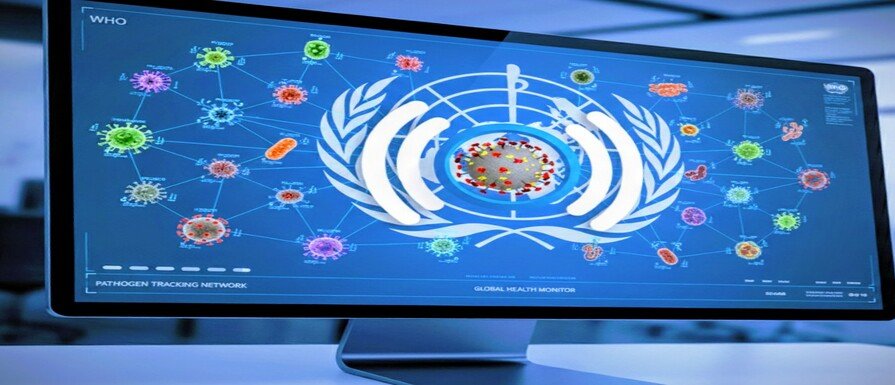
The WHO is enhancing its public health intelligence capabilities by scaling up its Epidemic Intelligence from Open Sources (EIOS) platform. EIOS is a platform designed to help detect, assess, and monitor public health threats using open-source data.

What is EIOS Platform?
EIOS operates as a global early-warning system by ingesting thousands of articles per hour from publicly available sources like news media, social media, government sites, and classifying them according to relevance to health threats.
Member States, regional bodies, and expert networks use it daily to strengthen surveillance and rapid response.
WHO’s Epidemic Intelligence from Open Sources system scans news, reports, and online data in real time to spot early signs of disease outbreaks and strengthen global health security.
Why the Upgrade Matters?
The initiative is part of WHO’s constitutional role as the coordinating authority for international health work, now leveraging technology to improve timeliness and accuracy of threat detection. As of mid-2025, 110 countries and 30 organizations are using EIOS to support public health decision-making.
Rapid expansion has stressed the system’s architecture, revealing challenges in scalability, integration, and performance. WHO’s Strategy 2024-2026 document notes that fragmentation and slow technological development are ongoing issues.
From Evidence from Practice:
A recent evaluation of EIOS in the African region shows it detected 81 % of public health events notified to WHO between 2018 and 2023, with sensitivity at 47.4%. In several countries, more than half of the events were identified by EIOS before official notification. An analysis in the Americas also shows EIOS’s role in boosting event-based surveillance across multiple nations after training and rollout support. During the FIFA World Cup 2022 in Qatar, EIOS complemented existing surveillance systems by filtering open-source articles for public health signals – a test of its utility in mass gatherings and large events.
What’s Next?
WHO-led initiative isn’t just about software. It’s also about building a global community of public health intelligence (PHI) – connecting institutions, training analysts, and integrating risk context (demographic, environmental, migration) into alerts.
In the coming years, WHO aims to improve interoperability, enhance scalability, integrate new data sources (including social media and community media), and strengthen analytic capabilities to ensure EIOS remains a frontline tool in global health security.