







Workplace safety has always been a moving target, and the risks workers face have only grown more complex with time. The new report on “Patent Landscape Report on Occupational Health and Safety Technologies (OHS)“ from the World Intellectual Property Organization (WIPO) shows how fast innovation is reshaping the way hazards are predicted, detected, and prevented across industries. The scale of change is striking, and the implications for global health are far-reaching.

The report builds on nearly two decades of patent data and is part of WIPO’s Development Agenda Project on reducing work-related accidents and occupational diseases through innovation. It highlights how governments, private industries, and researchers are expanding the boundaries of occupational safety.
More than 452,000 safety-related patents have been filed worldwide since 2000. Workplace safety is no longer just about helmets or alarms. It now includes AI systems, robots, new protective materials, and smart tools that monitor workers and their surroundings in real time.
Five Key Takeaways from the WIPO Safety Report
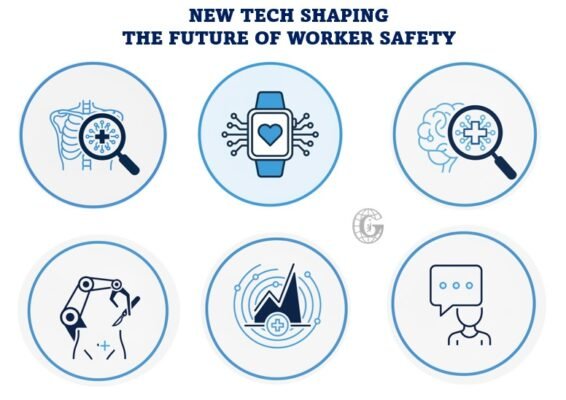
- Predictive safety technologies are the fastest-growing segment, driven by AI-ML models that warn workers before hazards escalate.
- Detection technologies are expanding rapidly through wearables, real-time environmental sensing, and location-based safety systems.
- Protection technologies still dominate, with strong activity in smart PPE, respiratory protection, and advanced ventilation solutions.
- China leads global patent filings, followed by the United States, Korea, Japan, India, and the European Union, showing a concentrated innovation ecosystem.
- New trends are emerging in robotics, climate-hazard monitoring, and psychosocial risk detection, pointing toward a more integrated and anticipatory safety model worldwide.
These points capture the structural shifts taking place in workplace safety and help explain how the field is moving far beyond traditional safeguards.
A Global Problem demanding Smarter Solutions
 The starting point is sobering. According to the International Labor Organization, almost 3 million workers die every year due to occupational accidents or work-related diseases. Tens of millions more are left with injuries that lead to disability or long-term health complications. These numbers are not just statistics; they show a global system still reacting after the damage is done. What the WIPO report makes clear is that the innovation pipeline is finally beginning to shift the balance from reaction to prevention. The technology being developed today is aimed at changing the conditions that put workers at risk in the first place.
Beyond the core pillars, the WIPO report reveals several emerging trends.
- AI-enabled inventions have grown more than four-fold since 2015.
- Climate-linked technologies are also on the rise. With heatwaves, floods, and poor air quality affecting millions of workers, companies are developing heat-stress forecasting models, UV-exposure sensors, and flood-risk alert systems.
- Mental health is entering the patent landscape through early-stage innovations for detecting workplace stress and burnout. These systems track speech patterns, behavioural shifts, and biometrics to identify early signs of overload.
- Meanwhile, robotics and drones are quickly becoming mainstream tools for hazard inspection, gas mapping, and remote intervention in high-risk zones. They reduce the need for workers to enter confined, unstable, or contaminated environments.
Why this matters for global health?
Workplace accidents and occupational diseases remain a major source of long-term disability, lost productivity, and preventable suffering. The new WIPO report shows that innovation is finally catching up to the scale of the challenge. What’s emerging is a more intelligent, anticipatory, and integrated safety ecosystem. In practical terms, this means the future of occupational health is shifting away from “respond after the injury” toward a model that understands the worker, the task, and the environment together. Safer workplaces ultimately translate to healthier populations, reduced health system burden, and stronger, more resilient economies.