






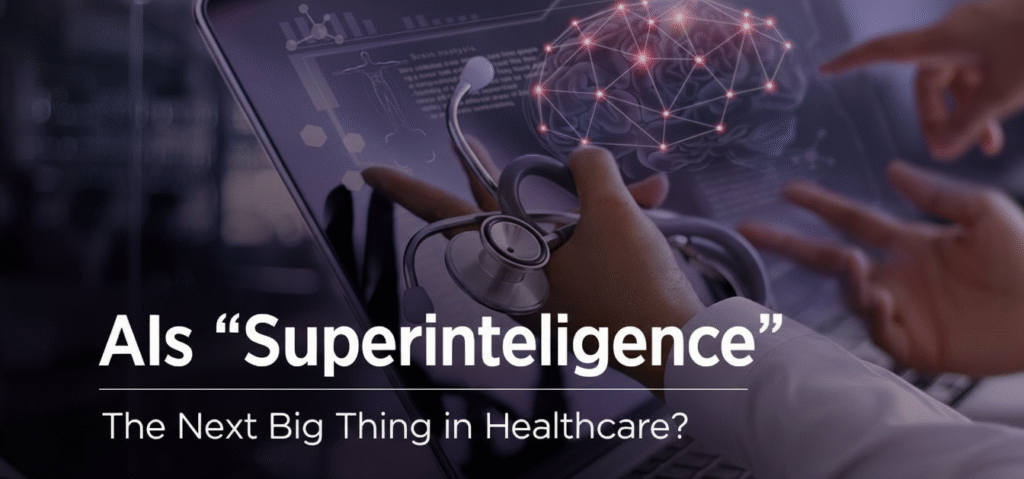
Microsoft has taken a bold step into the future of healthcare by launching a new superintelligence team aimed at one of the toughest challenges in medicine – diagnosing diseases faster and more accurately than humans. It’s an unexpected pivot in the AI race, and it has already started stirring global excitement and debate.
Superintelligence means an AI system designed to outperform human experts in a specific domain rather than replacing human intelligence entirely.
Announced this week, the new MAI Superintelligence Team will be led by Mustafa Suleyman, Microsoft’s AI chief and co-founder of DeepMind. While the tech world has spent years obsessing over Artificial General Intelligence (AGI), Microsoft says it is choosing a different path. Instead of trying to build a machine that can “do everything,” it wants an AI that can excel at one thing that truly matters – saving lives through early, super-accurate medical diagnosis.
A Race with Huge Stakes
According to Microsoft, advances in compute power and model design now give them “line of sight” to medical diagnostic AI with superhuman abilities within the next two to three years. That claim alone has turned heads. Medical diagnosis is complex, involving imaging, pathology, symptoms, lab results, and clinical reasoning. Even experienced specialists disagree on difficult cases. If AI can outperform human clinicians across specific diagnostic domains, the impact could be enormous.
Early and accurate diagnosis saves lives, reduces treatment costs, prevents disability, and can even stop outbreaks before they spread. The promise of an AI system that could detect cancer, cardiovascular events, infections, or rare disorders faster than human doctors is the sort of shift that doesn’t just improve healthcare. It redefines it.
How Microsoft Plans to Do It?
The new team will pull together top researchers across Microsoft, new hires, and existing AI assets. It will rely heavily on the company’s massive cloud and compute infrastructure which is something only a few organisations on the planet can offer.
Suleyman calls the approach “humanist superintelligence.” AI built specifically to serve human needs responsibly, with clear boundaries and clinical oversight, rather than acting as an all-purpose AGI.
The company is also positioning this move as a strategic counter to Meta, whose AI roadmap focuses on broad multimodal intelligence. Microsoft’s wants to build superhuman ability in a tightly defined area where accuracy can change the course of a patient’s life. If Microsoft succeeds, the benefits go far beyond big hospitals. Diagnostics are one of the biggest gaps in LMICs, Limited specialists, delayed lab reporting, and overloaded systems keep millions from getting timely care.
A reliable diagnostic “super-AI” could support:
- remote triage in emergencies
- rural and mobile screening services
- outbreak detection in real time
- faster interpretation of scans and labs
- clinical decision support for frontline workers
Medical AI still faces tough regulatory and ethical tests. Questions about bias, data protection, validation, and accountability will dominate the next phase. A misdiagnosis by a so-called superintelligent system could raise complex clinical and legal issues. But despite the hurdles, Microsoft’s move signals a shift in AI development which is heading toward high-impact missions with direct implications for global health. If this vision works, the biggest winner won’t be Microsoft , it will be the patient who gets the right diagnosis when it matters most.