





I. Overview
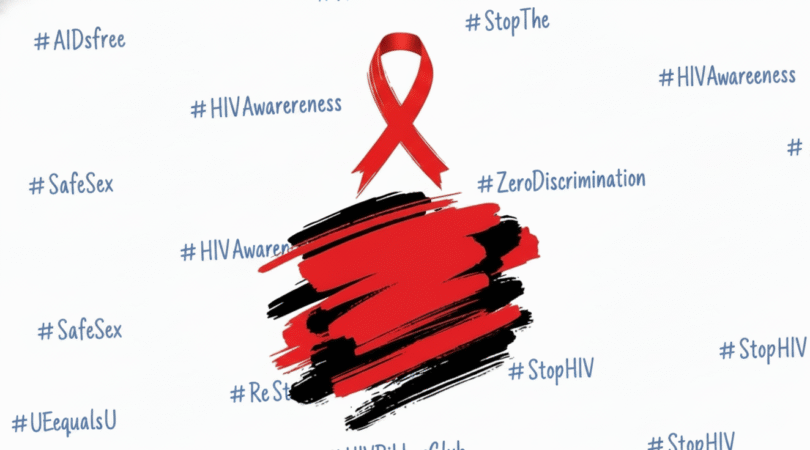
World AIDS Day is observed every year on 1 December to honour people living with HIV, remember those who died, and call for stronger action to end AIDS as a public-health threat. The day encourages solidarity, awareness and continued investment in prevention, testing, treatment and human rights. Established in 1988, it was the first-ever global health day and remains a vital platform for raising awareness, combating stigma, and promoting access to care and prevention services.
II. Significance of World AIDS Day
The 2025 theme calls for the importance of a rights-based approach to health, advocating for accessible, equitable, and stigma-free healthcare services for all individuals, especially those affected by HIV/AIDS. It highlights the need to confront inequalities and empower communities to claim their right to health.
III. What is HIV/AIDS?
HIV (Human Immunodeficiency Virus) is a virus that attacks the body’s immune system, specifically the CD4 cells (T cells), which help the immune system fight off infections. If untreated, HIV can lead to the disease AIDS (Acquired Immunodeficiency Syndrome), the final stage of HIV infection, where the immune system is severely compromised.
The UNAIDS 95-95-95 targets aim that by 2025:
95% know their status,
95% of those are on treatment, and
95% of those on treatment achieve viral suppression.
IV. Quick Facts about HIV/AIDS
- Around 45 million people globally were living with HIV in 2025.
- There is NO CURE for HIV.
- SDG Goal Target 3.3 focuses on ending the HIV epidemic by 2030.
- 1.3 million people acquired HIV in 2024.
- More than 600,000 people died from AIDS-related illnesses in 2024.
- About 87 percent of people living with HIV know their status.
- Nearly 76 percent of all people living with HIV globally are on antiretroviral therapy.
- Almost 4.5 million children and adolescents live with HIV.
V. A Brief History of World AIDS Day
1959: First confirmed HIV-positive human blood sample identified retrospectively in Kinshasa, DR Congo.
1981: First official recognition of AIDS as a disease. The CDC reported unusual clusters of Pneumocystis pneumonia and Kaposi’s sarcoma in young gay men.
1987: WHO launches Global Programme on AIDS.
1983: Virus that causes AIDS was isolated by Dr. Luc Montagnier’s team at Pasteur Institute, Paris
1988: First World AIDS Day observed, becoming the first-ever global health day.
1991: Iconic red ribbon adopted as global symbol of AIDS awareness.
2000: First UN Millennium Development Goals (MDGs) include halting HIV spread (MDG 6).
2005: PEPFAR (U.S. President’s Emergency Plan for AIDS Relief) launched.
2008: Luc Montagnier and Françoise Barré-Sinoussi awarded the Nobel Prize in Medicine for discovering HIV.
2016: UN launches 90-90-90 targets – 90% diagnosed, 90% on ART, 90% virally suppressed by 2020.
2019: “Undetectable = Untransmittable (U=U)” gains global acceptance.
2021: New UNAIDS targets 95-95-95 by 2025.
2022: WHO estimates 38.4 million people living with HIV globally.
VI. How to Observe World AIDS Day?
Wear the red ribbon and share facts to challenge stigma.
Promote HIV testing, prevention and treatment awareness in communities.
Support organisations working on HIV care, rights and advocacy.
Host school, workplace or public discussions to build understanding.
Share digital content that amplifies inclusive and accurate information.
References