








A new international climate study paints a scorching picture of the planet’s future unless emissions are curbed faster. Researchers from World Weather Attribution and Climate Central estimate that by the end of this century, the world could experience 57 additional “SUPERHOT” days per year, days defined as hotter than 90% of comparable dates from 1991-2020.

A World Getting Hotter, Faster
The analysis, released Thursday, uses climate models to compare temperature patterns from 2015 to present and project forward under two warming scenarios. If current emission pledges under the Paris Climate Agreement are met — limiting global temperature rise to 2.6°C above pre-industrial levels , the planet will still endure nearly two extra months of extreme heat annually. Without those commitments, the world would be heading toward 4°C of warming and 114 extra superhot days, effectively doubling today’s extreme heat burden.
“There will be pain and suffering because of climate change,” said Dr. Kristina Dahl, Vice President for Science at Climate Central. “But if you look at the difference between 4°C and 2.6°C of warming, that reflects the last ten years of effort and to me, that’s ENCOURAGING.”
Five Key Highlights of the Study
57 extra superhot days projected per year by 2100 under 2.6°C warming.
Without the Paris Agreement, it could go up tp 114 extra hot days.
Top 10 hardest-hit nations produce 1% of global emissions but get 13% of added heat days.
11 extra hot days already added since 2015.
Tens of thousands of additional heat-related deaths expected annually.
 The Unequal Toll
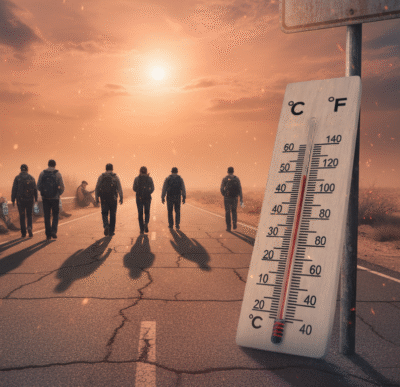 The Unequal Toll
The study exposes deep inequities. The poorest and smallest nations, many of them island or tropical countries, will bear the worst impacts despite contributing least to global emissions.
Panama, for example, could face 149 additional superhot days annually.
The top 10 hardest-hit nations, including the Solomon Islands, Samoa, and Indonesia, account for only 1% of global carbon emissions but will endure 13% of the added heat days.
In contrast, major emitters such as the United States, China, and India, responsible for 42% of global CO₂, will each add only 23-30 extra superhot days.
Already, the world has added 11 more superhot days on average since 2015, the report notes. Extreme heat is one of the deadliest natural hazards, contributing to hundreds of thousands of deaths annually, many in low-income regions without adequate cooling, healthcare, or infrastructure.
“That heat sends people to the emergency room. Heat kills people,” said Dr. Dahl.
Co-author Dr. Friederike Otto of Imperial College London added that the global death toll could reach “tens of thousands or even millions” as temperatures climb.
The 2023 southern Europe heatwave, for example, was 70% more likely and 0.6°C hotter than it would have been a decade earlier. Without stronger action, similar events by 2100 could be 3°C hotter, threatening agriculture, energy systems, and health networks.
While the Paris Agreement has prevented the most catastrophic scenarios, scientists stress that current pledges remain inadequate. “We are not on a safe path,” said Potsdam Climate Institute Director Johan Rockström, warning that even the 2.6°C trajectory “implies a disastrous future for billions.”