





I. Overview
World Leprosy Day (WLD) is observed every year on the last Sunday of January. The day draws attention to leprosy as a curable disease while highlighting the deep social stigma and discrimination still faced by affected persons. It serves as a reminder that elimination of disease transmission does not automatically end exclusion or human rights violations. In India, it is observed every year on 30 January, marking the death anniversary of Mahatma Gandhi.
“Leprosy is CURABLE, the real challenge is STIGMA” calls for a shift from fear to understanding, recognising that discrimination and social exclusion cause more harm than the disease itself. While effective treatment can cure leprosy completely, stigma delays diagnosis, isolates individuals, and undermines dignity. The theme urges communities to replace myths with facts, silence with support, and rejection with inclusion. True progress will come not only from curing the disease, but from restoring respect and equality to those affected.
III. What is Leprosy?
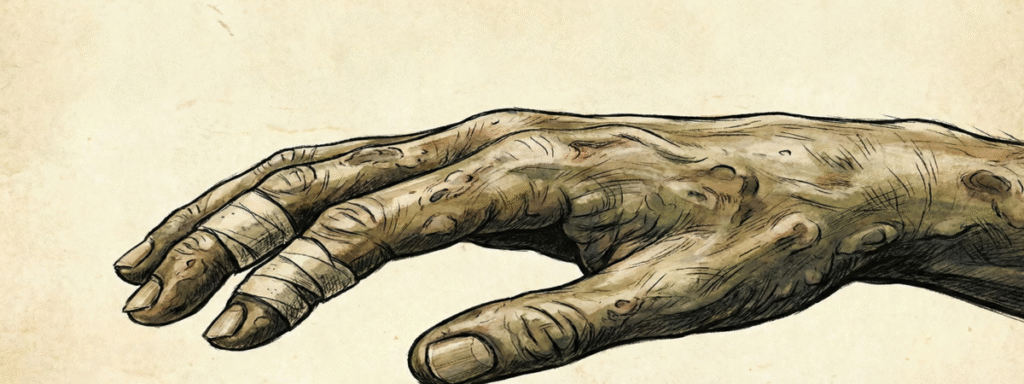
Leprosy, also known as Hansen’s disease, is a chronic infectious condition caused by a bacetria, Mycobacterium leprae. It primarily affects the skin, peripheral nerves, eyes and upper respiratory tract. The disease progresses slowly and, if detected early, is completely curable with Multidrug Therapy (MDT). When diagnosis is delayed, it can lead to nerve damage, loss of sensation, and physical disabilities. Leprosy is classified based on the number of skin lesions and the bacterial load (skin smear status).
Paucibacillary leprosy: Few skin lesions, low bacterial load, usually smear-negative, and milder disease.
Multibacillary leprosy: Multiple skin lesions, high bacterial load, often smear-positive, and more extensive disease.
IV. Quick Facts about Leprosy
- Leprosy is a curable neglected tropical disease (NTD)
- Leprosy is mentioned in the Bible and other ancient texts, showing how long the disease has been feared, misunderstood, and burdened with stigma across human history.
- From millions of cases in the 1980s to just 173,000 cases in 2024, shows remarkable progress,
- Majority of the cases are detected from South-East Asia Region.
- Leprosy was eliminated as a public health problem worldwide in 2000, meaning fewer than one case per 10,000 people. Most countries reached this level by 2010.
- In 2023, Brazil, India, and Indonesia each reported more than 10,000 new cases.
- Leprosy can rarely spread from animals to humans, with armadillos being the most well-documented animal reservoir.
- Despite exposure to Mycobacterium leprae, around 95% of people do not develop leprosy due to its low pathogenicity.
- A place where people affected by leprosy are made to live separately from society is known as a leper colony.
VI. How to Observe Leprosy Day?
Raise awareness: Share clear, factual information about leprosy, its symptoms, treatment, and how it’s transmitted. Help cut through myths and stigma in your community and online.
Make a pledge: Commit to a meaningful action that supports leprosy safety, dignity, and social inclusion.
Show your support: Use recognized leprosy awareness symbols or colors, or wear awareness ribbons or clothing.
Organize or attend events: Join or host talks, webinars, support meetings, and educational activities.
Support research and care: Donate to or volunteer with organizations working on leprosy.