





I. Overview
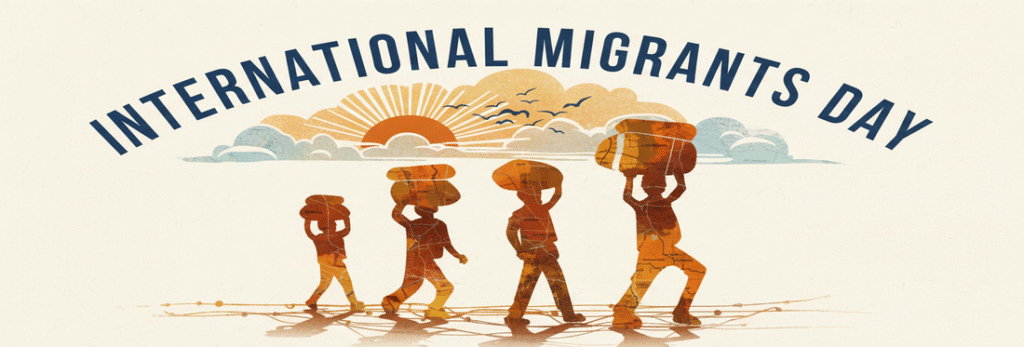
International Migrants Day is observed annually on 18 December to recognize the contributions and rights of the world’s 281 million migrants. The day honors their resilience and courage in seeking better lives and calls attention to the challenges they face such as discrimination, exploitation, and lack of access to basic services. It reinforces the global commitment to protect migrants’ dignity, safety, and human rights through cooperation, inclusion, and fair policies.
II. Significance of the Theme
The theme, “My Great Story: Cultures and Development,” calls for recognising migrants not as statistics or crises, but as individuals whose lived experiences, skills, and cultural identities actively shape social and economic development. It highlights how migrant stories reflect resilience, innovation, and contribution, and how cultural diversity strengthens communities, economies, and public life.
III. What is Migration?
Migration is not a marginal phenomenon. It is a defining feature of modern societies.
Migrant populations often face barriers that directly affect their health and wellbeing, including limited access to healthcare, unsafe working conditions, discrimination, language barriers, and legal insecurity. Many migrants work in high-risk, low-paid, and informal sectors where occupational hazards are common and social protection is minimal.
What this really means is that ignoring migrant issues does not just harm migrants. It weakens public health systems, increases health inequities, and undermines social cohesion. Inclusive migrant policies are essential for achieving universal health coverage, decent work, and sustainable development.
IV. Quick Facts about Migration
281 million people or 3.6% of the global population live outside their country of birth (UN DESA, 2024).
Around 169 million are labor migrants, contributing significantly to global economies.
Migrants send home over USD 831 billion in remittances annually – 3X times global foreign aid.
Climate change could displace up to 216 million people by 2050 in developing regions.
Women make up nearly half of all international migrants.
Migrant workers often face higher occupational risks and limited access to healthcare.
The COVID-19 pandemic disproportionately affected migrants, especially in informal sectors.
Migration contributes to innovation, entrepreneurship, and demographic balance in many host countries.
V. A Brief History of Migrants Day
1990: The UN General Assembly adopts the International Convention on the Protection of the Rights of All Migrant Workers and Members of Their Families.
2000: The UN designates 18 December as IMD to mark the anniversary of that convention.
2018: The Global Compact for Safe, Orderly and Regular Migration (GCM) is adopted, the first intergovernmental agreement covering all dimensions of migration.
2020-24: Global campaigns focus on inclusion, resilience, and post-pandemic recovery for migrants.
VI. How to Observe Migrants Day?
Host public discussions, exhibitions, or film screenings highlighting migrant stories and contributions.
Promote migrant rights through social media campaigns, art, or community engagement.
Advocate for inclusive labor laws and equal access to healthcare and education for migrants.
Partner with NGOs and local authorities to support migrant families and refugees.
Share accurate information to counter misinformation and xenophobia.