





I. Overview:
World Hospice and Palliative Care Day (WHPCD) is observed annually on the Second Saturday of October to raise awareness and support for hospice and palliative care worldwide. The day promotes compassionate care, relieves suffering, and calls for integration of palliative services into health systems so that people with life-limiting illnesses live with dignity and comfort.
II. Significance of the Theme:
The present theme shows the commitment to expand equitable access to palliative care services globally, especially in underserved regions. It builds on WHO and global health commitments, aiming to embed palliative care within universal health coverage (UHC) and to empower communities, influence policy, and strengthen healthcare systems.
 III. What is Palliative Care, and How it is Different from Hospice?
 III. What is Palliative Care, and How it is Different from Hospice?
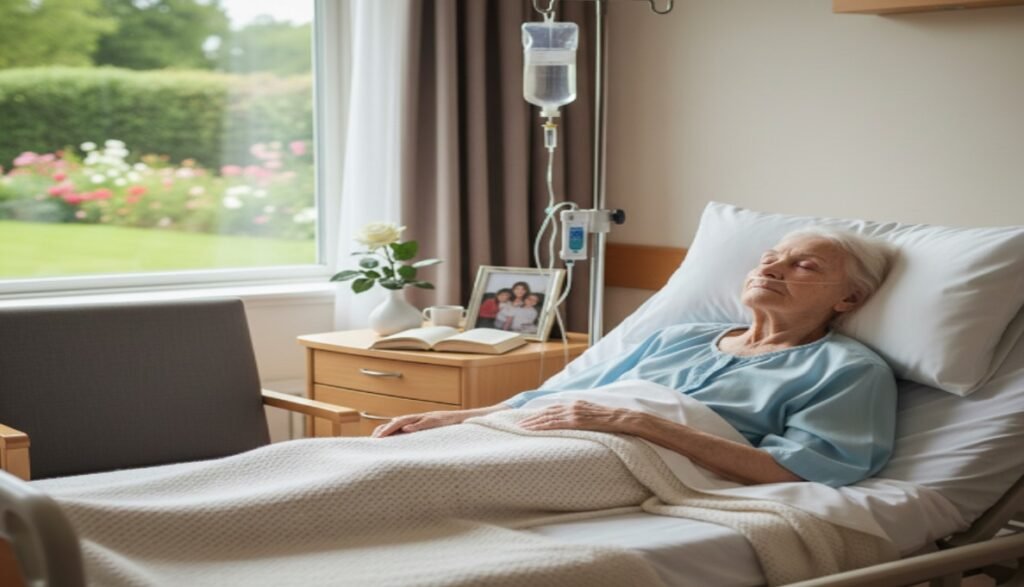
Palliative care is special medical care that helps people with serious or long-term illnesses feel better. It focuses on improving quality of life by managing pain and other symptoms, and by supporting emotional, social, and spiritual needs.
It is not only for the end of life – palliative care can be given at any stage of an illness, even while the person is still getting treatment to cure or control the disease.
Palliative care and hospice care both focus on comfort and quality of life, but they differ mainly in timing and purpose:
Palliative care can start at any stage of a serious illness. Its goal is to ease pain, manage symptoms, and provide emotional and social support.
Hospice care is for people who are in the FINAL PHASE of life, usually with a a very less life expectancy, and who have stopped curative treatments. The focus is entirely on comfort, dignity, and support for both the patient and their family.
IV. Quick Facts about Hospice & Palliative Care: 💡
- WHO reports nearly 57 million people globally need palliative care, including 25.7 million near the end of life.
- Fewer than 1 in 7 individuals requiring palliative care have access to the support and services they need.
- Around 7% of the global palliative care need is among children, mainly due to congenital anomalies, and cancer.
- More than 85% of people who need palliative care live in LMICs, but only a fraction receive it.
- Only about 14% of countries worldwide have comprehensive palliative care services integrated into their health systems (WHO Global Atlas of Palliative Care, 2020).
V. A Brief History of WHPCD:
2005: The day was first organized by Worldwide Hospice Palliative Care Alliance (WHPCA)
2019-20: During the Pandemic times, the focus was on “My Care, My Comfort, My Right”.
2021: The theme “Leave No One Behind – Equity in Access to Palliative Care” resonated strongly as it emphasized fairness, inclusion, and reducing disparities in palliative care access globally.
2024: “10 Years Since the Resolution: How Are We Doing?”, marking a decade since a World Health Assembly resolution on palliative care.
2025: Current theme “Achieving the Promise: Universal Access to Palliative Care” focus towards a future where the promise of universal access is realized for everyone.
VI. How to Observe WHPCD?
Host community forums, webinars, or panel discussions on palliative care access and needs.
Share patient and caregiver stories to humanize the experience of serious illness and compassionate care.
Advocate for policy change to integrate palliative care into national health systems, UHC packages, and essential drug lists.
Collaborate with health ministries, NGOs, and civil society to raise funding, awareness, and training.
Use media and social media to amplify the theme “Achieving the Promise”, emphasizing equitable access.
References:
- https://www.who.int/news-room/fact-sheets/detail/palliative-care
- https://ehospice.com/international_posts/world-hospice-and-palliative-care-day-theme-2025/
- https://www.palliativecare.in/